Bridging Global Borders through Seamless Digital Excellence in Kolkata
At CIMAC Marketing we are aware that collaboration is more than a regular digital workspace and project management board. It’s the result of real connection, authentic communication and common culture.
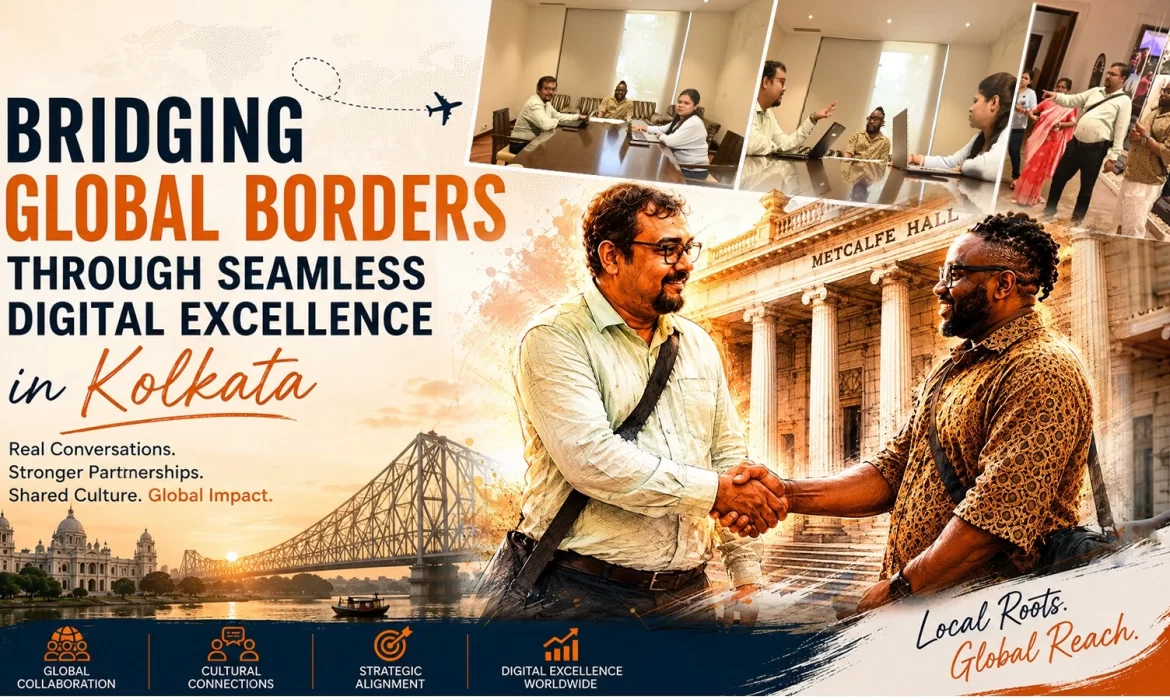
We are blessed to have had the opportunity to have our esteemed partner and client Joe from the United States here in our home city of Kolkata recently. Digital tools can help us reach multiple time zones and drive campaigns without a moment’s hesitation; nothing can beat face-to-face interaction and clarity.
Being a leading digital marketing company in Kolkata, hosting our international partners is not only a way to highlight the historic attractions of our city, but also to build a strong, untouchable base for a cooperation that is a master of the globe.
1. In addition to the Boardroom, strategic alignments and cultural footprints
This tour with Joe was a great mix of business and top-level discussions and an immersive tour of the rich history of Kolkata. This trek through the soul of our home city was a wonderful reminder to us of the CIMAC philosophy: “We don’t manage workflows, we build and nurture lifelong relationships”.
Acknowledging Heritage at Metcalfe Hall
It was appropriate that our first stop was the historic Metcalfe Hall where we shared the history of global trade, culture and collaboration. This building marvel talked to us of the history of Kolkata as a world centre of commerce and also inculcated us with a sense of value of building strong international ties.
Cultural Alignment: Appreciating and understanding the ‘why’ so that the international brand message can be delivered in the local execution.
Total Transparency: Transparency & complete visibility, irrespective of time zones and geographical boundaries.
2. Serene Moments by the Ganga at Prinsep Ghat
The peaceful scene at the foot of the Ganges at the Rinjhi Ganges, also known as Prinsep Ghat.
As is our tradition in Kolkata, some of our best ideas came out of our meetings not in the meeting rooms, but by the peaceful waters of the Ganga at Prinsep Ghat. The setting was a rare break, and a reflection that was, naturally, a part of the strategy, with the iconic Vidyasagar Setu rising in the horizon.
We remained silent, thinking of the still waters of the river, steady, adaptable and purposeful in our approach to work.
In the best digital marketing agency in India, we do just that. We are never distracted from our ultimate goal, both with our big international campaigns and our scalable SEO structure: consistent and impactful results, without crossing borders for collaboration.
Building true partnerships isn’t about dashboards and deliverables; it’s about shared experiences, trust and a common vision of growth.

Why International Brands Choose CIMAC Marketing
To sum up, a fantastic example of how we are doing things with our clients around the world. We operate in relation to one another in a way that is comfortable, clear and always aligned (like our Kolkata trip with Joe).
We’re not just involved with our clients’ strategy delivery process, we’re part of their growth journey, having successfully delivered strategies for brands in the UK and elsewhere in the world.
This expertise of the local market, combined with global best practices, is what differentiates us from the competition as the top digital marketing agency in Kolkata and guarantees results that can be felt in the company’s operations.
What is a True World Class Partnership?
Seamless Execution
The entire process, from planning to performance monitoring, is streamlined and optimized for clarity, efficiency and ROI.
Adaptive Strategies
We adapt to algorithm changes, market fluctuations, and business objectives – keeping your brand always in the lead.
Your Own Team Extension.
We’re not your external vendor, we’re your growth partner who is in this to see you succeed.
Creating your profile worldwide
Whether you’re a small startup in India or a global brand looking to make a wider reach, CIMAC Marketing is here to bridge the gap between ideas and actions.
We devise strategies and implement them, collaborate and execute them successfully in the long-term.
Join hands with the Best Digital Marketing Agency in Kolkata Today! → https://cimacmarketing.com/
The Whole Alabama Dental SEO Strategy
The Alabama dental clinics are working within a highly competitive online space where online visibility is a direct influence on patient acquisition. As an increasing number of patients use Google Search and Google Maps to locate dental services, clinics without a developed search engine optimization strategy tend to lag. This report provides an in-depth guideline to assist dental practices to take over the search results in the area, enhance their visibility and transform web traffic into tangible patient appointments.
Alabama Dental Clinic SEO Current State
Current Performance Problems
A close examination of Alabama dental web sites shows that there are multiple problems that are recurrent crippling their Internet development. The majority of websites rank lower than 300 key words which really curtails their search presence. Moreover, there are numerous clinics, which have fewer than 600 monthly organic visits, which means that they do not use the options of SEO well.
The excessive dependence on branded searches is another issue of great concern. This is because the majority of traffic is served by individuals who are already familiar with the clinic and not new potential patients who learn about the business on their own. There is also weak backlink authority that decreases the credibility of Google algorithm and such sites cannot be ranked competitively.
Opportunity for Growth
In spite of these, the landscape offers an enormous opportunity. With a properly designed system of SEO, the clinics will be able to easily surpass their rivals and take up most of the local search engines, Google Maps, and keyword-specific searches.
Alabama Dental Search Engines Opportunity.
Intensive Demand in Search across Cities.
Birmingham, Auburn, Opelika, Montgomery, Hoover, and Tuscaloosa are cities that have a high level of demand for dental services. The patients often include such keywords as dentist near me, dentist in Birmingham AL, and emergency dentist Opelika.
Gap in Keyword Targeting
The problem is that most dental clinics are unable to use these high-intent keywords. Rather, they believe in their brand name and this restricts their coverage. The clinics can attract more organic traffic and patient requests by focusing on wider and more relevant keywords.
CIMAC Dental SEO Authority Model.
There are Four Pies of SEO Authority.
Clinics need to establish authority in four layered levels to dominate the local SEO:
- Layer 1: The dominance of Google Business Profile.
- Layer 2: Local service pages
- Layer 3: Educational content
- Layer 4: Local backlinks
These layers ensure that the engine result is that the clinic is seen as a reliable local authority, leading to better ranking and more traffic.

Alabama Dental Clinics Keyword Strategy.
Local Intent Keywords
These are very conversion-specific keywords because they will focus on users who are interested in dental services offered in a particular area.
They are such as a dentist in Birmingham AL, dentist in Auburn AL, and family dentist Birmingham. These are keywords that will spur booking of appointments and should be given priority.
Treatment-Based Keywords
Treatment keywords are used to reach out to the patients that are aware of what they want. They are dental implants Birmingham, teeth whitening Auburn AL, Invisalign Birmingham AL, and cosmetic dentist Alabama.
These are the keywords that are generally of high commercial intent and result in quicker conversions.
Emergency Keywords
Urgent searches like emergency dentist near me, urgent dentist Auburn, and tooth extraction Birmingham are converted with a very high speed because of urgency.
Informational Keywords
Informational searches such as length of Invisalign treatment, dental implants cost, and root canal symptoms are used to create authority and get a top-of- funnel traffic.
The Perfect Dental Web Site Design.
Homepage Optimization
The key word that the homepage should aim at is Dentist in [City], Alabama. It has to have a powerful hero section, description of services, client testimonials, information about insurance, and a clear call to action to make appointments.
Core Service Pages
A separate page should be devoted to each dental service. They are dental implants, Invisalign, root canal treatment, emergency dentist and teeth whitening.
An explanation of treatment procedures, symptoms, procedure steps, recovery care, and cost estimates, a frequently asked question section, and even appointment CTAs need to be found on these pages.
City Landing Pages
One of the largest areas of ranking is the city-specific pages. Localized content, services to be offered, directions, reviews of the patients, and appointment form must be provided in each page.
Blog Content Hub
The medical blog section would be answering generally asked questions to the patients like: does teeth whitening affect the enamel, are root canals painful, etc. This generates topical authority and enhances SEO performance.
Google Business Profile Optimisation.
Importance of Google Maps
Google Maps leads to over half of dental leads and is thus a very essential part of local SEO.
Optimization Checklist
The profile should also contain the right major classification like Dentist but secondary classification like Cosmetic Dentist and Emergency Dentist.
Clinics are to post high-quality photos such as clinic interiors, treatment rooms, staff photos and before and after-results.
Reviews and Engagement
Creating more than 150 Google reviews is a significant advance in the rankings and the creation of trust. It is important to post weekly updates in the form of dental tips, stories of success, and offers to keep the interaction.
Alabama Clinic Backlink Strategy.
Current Backlink Trends
The majority of the dental websites use cheap directories like DexKnows and SuperPages. Although they are of some value, they cannot deliver good results in terms of SEO.
Backlink Sources of high value.
Clinics must also aim at getting backlinks to established healthcare directories including Healthgrades, Zocdoc, WebMD, and Vitals.
Chamber of commerce and medical association quotes are also local references and enhance credibility.
Local authority is also increased by local sponsorships, school sponsorship and the community based links like charity events and local joint ventures.
Local SEO winner content strategy
Significance of Education Materials
A lot of dental websites do not focus on information content even though it is in high demand in the search. Posting materials on such subjects as the cost of dental implants, the advantages of Invisalign, the stability of veneers, and symptoms of cavities can be used to appeal to more readers.
Gathering Topical Authority
Regular creation of content sends a message of knowledge to the search engines, enhancing ranking in various keywords and boosting the authority of the site as a whole.
Local SEO Winning Content Strategy.
Significance of Educational Content.
The informational content is not concentrated on in many dental web sites as it is in high demand as well. It is better to publish information on such subjects as the price of dental implants, advantages of Invisalign, the life span of veneers, and the symptoms of a cavity to attract more readers.
Authoritative Topics.
Regularity in the creation of content is also an indication of expertise to search engines that enhance rankings in a variety of keywords as well as the general authority of the site.
Technical SEO Checklist
Page Speed Optimization
The websites must take less than three seconds to load so that the user experience is not interrupted and to attract better ranking.
Mobile Optimization
Responsive design is also necessary given that dental search is being done on mobile devices more than 70 percent of the time.
Data Implementation Structured.
The schema markup that includes Dentist, LocalBusiness, FAQ, and Review will help increase the search visibility and rich results.
Internal Linking
The internal linking helps in spreading the authority among related pages improving the navigation of the web site.
Local SEO Timeline
Month 1
The optimization of Google Business Profile, restructuring of the web page, and keyword search start.
Month 2
There are service pages published (city landing pages) and citation listing.
Month 3 to 4
Backlinking, writing of the blog posts, and review generation commence.
Month 5 to 6
The rankings in search engines become better, Google Maps becomes visible, and patient leads are as well enhanced.
Alabama Clinics make SEO errors.
Branded Search Overreliance.
Most clinics only rely on brand-based traffic which limits the growth.
Thin Content Pages
Service pages are usually not in-depth. Preferably, every page is supposed to have between 1000 and 1500 words and thoroughly developed frequently asked questions as well as localized references.
Ignoring Local SEO
The inability to produce city-targeted contents leads to the missed ranking possibilities.
SEO Traffic into Patients.
Conversion Optimization
Traffic alone is not enough. Websites should turn web traffic into patients by using obvious calls-to-action like Schedule Your Appointment Today, Call Now, or Book Online.
Online Scheduling Functionalities.
It is better to provide online booking of appointments, check insurance, and emergency requests to enhance user experience and gain conversions.
Trust Signals
Pre-after-photos, certifications, and testimonials of patients will create trust and urgency to act on the part of patients.
Alabama Dental SEO Benefit
Alabama clinics have a rare opportunity owing to the relatively poor SEO tactics used by their competitors. Through a systematic and systematic search strategy, the dental practice will be able to take control over Google Maps, the unpaid search engine, and treatment-related keywords.
How CIMAC Marketing Assists Dental Clinics to Rank.
Strategy Overview
CIMAC Marketing is devoted to the establishment of the local SEO power, the development of the conversion-oriented pages, the establishment of the content-based traffic and the control of the online image.
Results Delivered
This would guarantee steady patient acquisition via organic search and would allow clinics to have a sustainable and scalable acquisition system.

Google Ads V/s Facebook Ads: Which Will Get You A Better ROI?
It is one of the most asked questions in the digital marketing world. There’s constant competition going on between the two platforms, both having millions of users.
Marketers use the two platforms for advertising as they maximize visibility, thereby increasing leads and sales. But the two ad platforms work in different ways, and which one you need depends on your goals.
Google Ads
Google Ads, also referred to as Paid Search, is the world’s largest and even one of the two most popular PPC platforms. The other one is Bing Ads.
Paid Search focuses on keywords like some specific words and phrases likely to be used by a user and text-based advertisements. The ads are displayed on the search results. And each time the user clicks on the ad, a charge I paid by the advertiser. So, it is known as “Pay-per-click advertising”.
Marketers pay charges to gain new customers and achieve their goals.
Facebook Ads
Facebook Ads is also known as Paid Social. This is because it is a social networking platform where advertising products are conventional. Being at the top rank of monthly active users, Facebook has become a highly competitive platform used for digital marketing.
Google Ads V/s Facebook Ads: Which Will Get You A Better ROI?
Unlike paid search, which brings businesses via their search queries, paid social help to find companies based on their interested items and the ways they behave online.
Google Ads help marketers find new customers, while Facebook Ads help new customers to marketers.
Google Ads will help you generate leads right away and give out an instant ROI on your investment while Facebook Ads will help new customers to get aware of your brand name and your products. This way will help to generate leads and better ROI in the long run.
So, choose wisely. Because their competition will never end.
